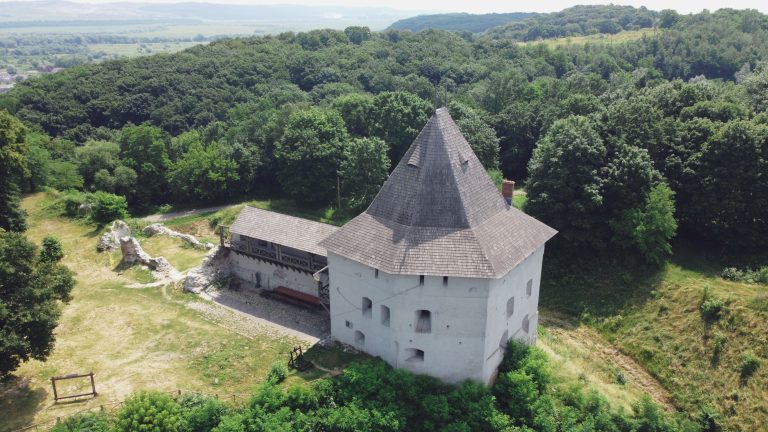
Castle Hill in Halych has long attracted people traveling through our region, drawing the attention of scientists, historians, and local lore specialists. It is a unique symbol and calling card of the city. This is no coincidence, as from here, from the height of Galych Castle, a beautiful panorama of the ancient and modern city above the Dniester opens up. And the ruins of the castle remind us of the glorious past of our land. The prominent historian, the first researcher of ancient Halych, A. Petrushevych, even believed that the chronicle city with Volodymyrko’s palace and the court church of the Savior stood on Castle Hill in Halych. However, the discovery of the foundation of the Assumption Cathedral in Krylos by Ya. Pasternak in 1937 clarified everything. Researchers agreed that in princely times, the site of modern Halych was a trading port, and Castle Hill housed a fortification of defensive significance. Today, we know that it is one of the oldest and most fortified strongholds in Galicia.
Galych Castle was built in the mid-14th century. However, its predecessor was first mentioned in 1114 as a fortified citadel. Archaeologists believe that it was initially a wooden structure, which later grew into a strong castle of the Galician princes (12th-14th centuries). The Polish historian E. Heleniush, in his work “Conversations about the Polish Crown,” states: “Halych, right on the Dniester, has an ancient castle, whose origins are not mentioned by chroniclers or traditions…” – and then asserts that with the decline of the capital, “only the castle on the Dniester reminded of the city’s former significance…”. It is unknown who and when destroyed the princely wooden castle. We only know that the reconstruction of the castle, as a defensive outpost of the Halych starostvo, began in the mid-14th century, after Galicia and Western Volhynia became part of Poland. Some historical sources attribute the construction of the wooden-earthen castle to Casimir the Great, while others claim that the stronghold was built by the Volhynian voivode Liubart in 1350-1352. In any case, it is known that Galych Castle was rebuilt for almost a whole century, and from the end of the 14th to the 15th century, it was one of the largest in Galicia. At that time, its garrison numbered over a thousand people. The castle had several dozen small cannons and many firearms.
Galych Castle was stormed in 1490 by a peasant army led by Mukha, and in 1620 and 1621, the Tatars tried to capture it. During the liberation war of the Ukrainian people (1648-1654), the stronghold was besieged by S. Vysochan’s army, and in the summer of 1649, the fortress was captured by B. Khmelnytsky’s troops.
The castle was rebuilt in the 17th century by the Halych starost A. Potocki, who allocated 42,000 zlotys for this purpose. The Sejm Resolution of 1658 states that A. Potocki restored it at his own expense: “from the ground, he erected new walls and surrounded them with trenches and redoubts in a foreign manner.” The reconstruction plan was developed by the Italian engineer François Corrazini. The rebuilt castle had a triangular shape, covered an area of 1.7 hectares, had two terraces, three stone towers at the corners, nine storerooms, an archive of city and land acts, a chancellery, and court premises. The castle also had a chapel of St. Catherine.
Galych Castle suffered its next blow during the Turkish-Polish War of 1676. The troops of Ibrahim Shaitan Pasha captured the stronghold. The garrison, led by Commandant Liakhovsky, surrendered the castle almost without a fight. The Turks plundered it and blew up part of the defensive walls and towers. Subsequently, the castle was rebuilt, but due to the construction of the new fortress city of Stanislaviv, the Halych stronghold gradually lost its defensive significance and fell into disrepair. According to the governor’s order, in 1767, part of the surviving walls was dismantled, and the material was used for building the city near the pier. The ruins that remained from the ancient fortress loomed over Halych until the end of the 20th century.
Today, Galych Castle is protected by the state. According to the General Plan for the Development of the “Ancient Halych” National Reserve for 2001-2005, restoration work is being carried out here. The restoration project for this national monument includes restoring the surviving walls, the southwestern tower, and the Chapel of St. Catherine, and recreating the defensive wall between the tower and the chapel.